April 11, 2026

A chimpanzee war in Uganda has broken into global news and caught the attention of millions. Coming at a time when the world has been gripped by conflict between the USA, Israel and Iran, news about chimpanzees fighting a war in Africa seemed like satire at first. It inspired no shortage of jokes — chimps closing the “Strait of Hormuz”, demanding taxes, the works. But the war unfolding inside Uganda’s Kibale National Park is very real, and has now been confirmed in a landmark study published in the journal Science.
So how did it come about?
How Chimps Live
To understand the war, you first need to understand how chimpanzees organise themselves. Chimps are man’s closest relatives, sharing more than 98% of our DNA, and like humans, they live in structured communities. These communities are territorial — one group’s range is off-limits to outsiders — and they have clear hierarchies, with leadership, social classes, and rules governing how individuals interact based on status.
When leadership is stable, these communities function peacefully for decades. But when it breaks down, competition for influence can fracture even the most cohesive group.
The Ngogo Community
The Ngogo chimpanzees of Kibale National Park are the largest known wild chimpanzee community ever studied — nearly 200 individuals living together in relative harmony for over 20 years. Scientists have followed them continuously for three decades. If you’ve watched “Chimp Empire” on Netflix, these are the chimps you saw.
For most of that time, Ngogo was a model of chimpanzee stability. Subgroups formed and dissolved fluidly, but everyone still got along. Then, around 2014, things began to unravel.
How the War Started
In 2014, a disease outbreak killed several key males within the community — individuals who had played an important role in bridging different social clusters within Ngogo. With those connections gone, two factions began to pull apart: a Central group and a Western group. Reproductive competition between the groups added further tension. By 2015, low-level hostility had broken out. By 2018, the split was permanent.
What followed was devastating. The Western group — despite starting as the smaller faction — launched coordinated raids into Central territory. By 2026, at least 28 chimpanzees had been killed, including 19 infants.
Lead researcher Prof. Aaron Sandel of the University of Texas put it plainly: “We almost excuse war between groups. But we’re really troubled by civil war — by cases where neighbours turn on neighbours.” His study shows that in chimpanzees, as perhaps in humans, you don’t need ethnic or ideological differences to produce lethal collective violence. Fractured social bonds alone can be enough.
How Violent Are Chimps?
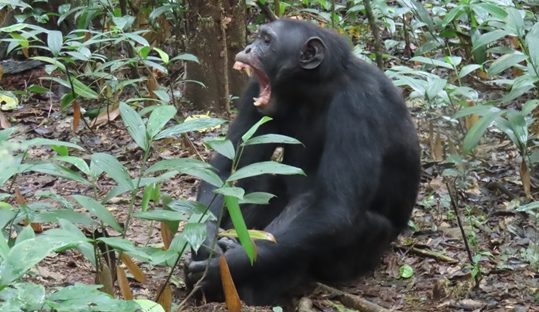
Very. Jane Goodall, the pioneering primatologist who spent decades living among chimpanzees in Africa, once remarked in an interview that chimps are “just like us” — implying that their capacity for violence mirrors our own, for similar reasons and on a similar scale (read how strong and violent is a chimp). The Ngogo war bears that out. The attacks have been vicious: coordinated ambushes, targeted killings of adult males, and raids in which infants were killed.
This is the second chimpanzee “civil war” ever documented. The first was observed by Goodall herself in Tanzania’s Gombe National Park in the 1970s, in what researchers called the Four-Year War.
Why This Matters for Visitors
Kibale National Park is one of Uganda’s premier wildlife destinations, and chimpanzee trekking here is one of the most compelling wildlife experiences in East Africa. Walking into the forest and spending time among these animals — watching their social dynamics, their hierarchies, their relationships — is extraordinary at any time. Right now, with the Ngogo community at the centre of global scientific attention, it is even more so.
Chimpanzee trekking is also available in Rwanda’s Nyungwe Forest, another remarkable destination. Rwanda is better known for its mountain gorillas, who have a markedly different social structure — and are considerably less aggressive, despite being the most physically powerful of the great apes.